

 Blog
BlogUnlock the Natural Oil Potential of Avocados Through a Controlled Process
Originating from Central Mexico, the avocado is the fruit of a tree belonging to the laurel family (Lauraceae). In addition to tropical climates, avocados can also be grown in subtropical and Mediterranean climate regions where severe frost events do not occur. Depending on the variety and growing conditions, ripe avocado fruit may contain approximately 10–25% oil.
Efficient avocado oil production requires proper cleaning of the fruit, controlled separation of the pit and peel from the flesh, preparation of a homogeneous paste, and precise separation of the oil from the solid and liquid phases.
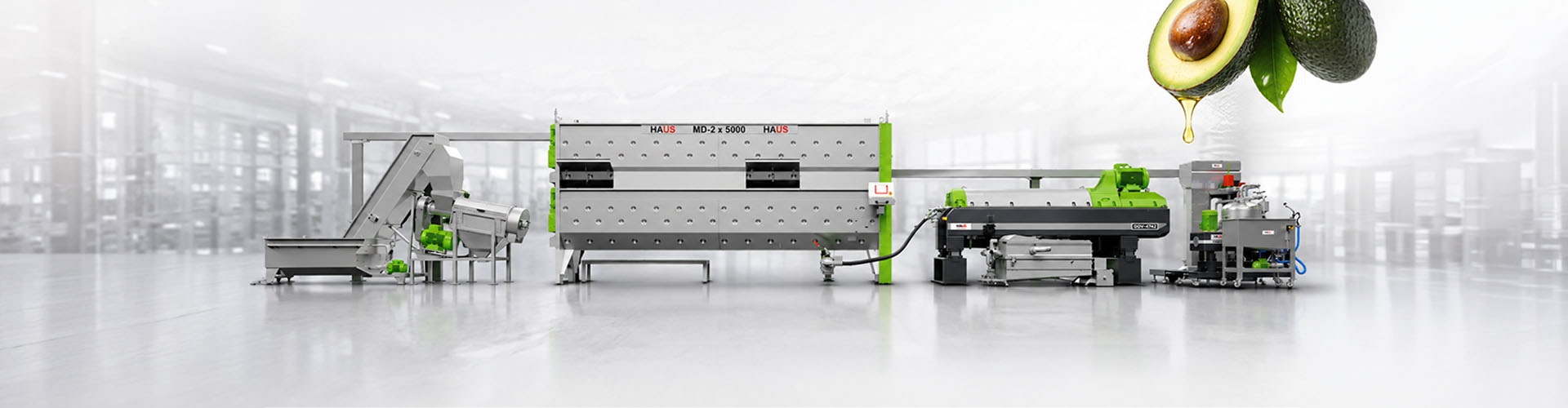
The HAUS Avocado Oil Processing System provides a continuous production solution comprising compatible equipment for the process from feeding raw avocados into the production line through obtaining high-purity avocado oil.
HAUS Avocado Oil Production Process
In continuous-system avocado oil production lines, fruit is fed into the process from one end while cleaned and purified avocado oil is obtained through the subsequent processing stages.
The main equipment used in the HAUS avocado oil processing process includes:
- Avocado washing machine
- Avocado pit separator-crusher machine
- Malaxer
- Decanter centrifuge
- Separator (vertical centrifuge)
Process Operation
1. Preliminary Inspection and Raw Material Preparation
When the avocados arrive at the processing plant, they first undergo a preliminary inspection. Damaged, rotten, or otherwise unsuitable fruit is sorted out before entering the production line.
The inspected avocados are transferred continuously and in a controlled manner to the washing unit via the conveyor system.
2. Washing the Avocados
The avocado washing machine is the first main piece of equipment in the production line. It removes soil, sand, dust, and other foreign materials that accumulate on the fruit surface during harvesting and transportation.
The avocados are first placed in the water tank to soften coarse dirt and soil residues on their surfaces. After surface cleaning by water circulation, the fruit is rinsed by spraying with clean water.
After washing is complete, the avocados are directed to the conveyor belt and air-dried during transfer.
Benefits of the Avocado Washing Machine
- Effectively removes foreign materials from the fruit surface.
- Contributes to establishing hygienic production conditions.
- Supports the reduction of the microorganism load on the fruit surface.
- Helps downstream process equipment operate more efficiently.
- Helps reduce crushing and product losses while preserving fruit integrity.
- Supports reduced water consumption and operating costs through the water recovery system.
3. Pit Separation, Peel Separation, and Crushing
The washed avocados are fed continuously and in a controlled manner into the avocado pit separator-crusher machine via a conveyor.
The machine’s special rotor system breaks down the fruit in a controlled manner, separating the peel, fruit flesh, and pit from one another. The pits are separated from the fruit flesh through a special screen system that utilizes differences in size and hardness, and are discharged from the system through a separate outlet.
The pitted fruit flesh is broken down to the desired particle size within the rotor and screen system to produce a homogeneous puree.
The homogeneous avocado paste obtained at this stage is suitable for the malaxation process.
Benefits of the Pit Separator-Crusher Machine
- Performs pit separation and fruit flesh preparation in the same machine.
- Helps protect downstream process equipment by removing pits from the production line.
- Produces avocado paste with a homogeneous particle structure.
- Supports increased oil extraction efficiency.
- Contributes to more efficient malaxation.
- Its continuous-production design makes it suitable for high-capacity processes.
- Supports product quality by breaking down the fruit flesh in a controlled manner.
4. Malaxation
The avocado paste prepared in the pit separator-crusher machine is fed continuously and in a controlled manner into the malaxer using a lobe pump.
Inside the malaxer, the avocado paste is gently mixed at low speed and controlled temperature by the screw system. During this process, the small oil droplets in the paste coalesce into larger droplets, allowing the oil to be released from the fruit tissue.
During the malaxation stage, carried out under conditions appropriate to the type of avocado being processed and the process requirements, the avocado paste is malaxed in a controlled manner at 30–45 °C for approximately 40–45 minutes under reference process conditions.
As a result of malaxation, the avocado paste becomes suitable for separation of free oil, liquid phase, and solids in the decanter centrifuge.
5. Phase Separation with a Decanter Centrifuge
After malaxation is complete, the avocado paste is fed into the HAUS decanter centrifuge to separate the oil from the solid phase and vegetation water.
The high centrifugal force generated inside the decanter separates the avocado paste into phases according to differences in density.
The process produces three main outputs:
- Avocado oil phase
- Liquid phase
- Pomace or cake phase
The quantities of liquid and pomace at the decanter outlet may vary depending on the variety, ripeness level, moisture content, solids content, and oil content of the processed avocados.
The crude avocado oil obtained from the decanter centrifuge is directed to the disc stack separator for final purification.
6. Oil Purification with a Separator (Vertical Centrifuge)
The crude avocado oil from the decanter outlet may contain a certain amount of free water, fine solid particles, and sediment.
The crude oil is fed to the HAUS separator at the final purification stage. The high centrifugal force generated by the separator removes free water, fine solids, and sediment from the oil phase.
This process produces high-purity avocado oil free from liquid and sediment.
Key Benefits of the HAUS Avocado Oil Processing System
Continuous Production
Compatible process equipment creates a continuous production flow from raw material feeding through oil purification.
Controlled Raw Material Preparation
Washing, pit separation, and controlled size reduction stages that preserve fruit integrity prepare the avocado flesh appropriately for malaxation.
Homogeneous Avocado Paste
The rotor and screen system produces a homogeneous paste with the appropriate particle size, supporting efficient operation of the subsequent process stages.
Controlled Malaxation
Gently mixing the avocado paste at low speed and controlled temperature helps the oil droplets coalesce and be released.
Efficient Phase Separation
The decanter centrifuge separates the avocado paste into oil, liquid, and pomace phases, performing the primary separation stage of the continuous extraction process.
High-Purity Oil
The disc stack separator removes free water, fine solid particles, and sediment from the oil at the decanter outlet to obtain high-purity avocado oil.
Efficient Use of Resources
The water recovery system used in the washing machine contributes to reducing water consumption and associated operating costs.
HAUS Equipment Used in the Process
| Process Stage | HAUS Equipment | Primary Function |
|---|---|---|
| Raw material preparation | Avocado Washing Machine | Removal of soil, sand, dust, and foreign materials from the fruit surface |
| Pit and peel separation | Avocado Pit Separator-Crusher Machine | Separation of the pit and peel, and size reduction of the fruit flesh |
| Paste preparation | Avocado Pit Separator-Crusher Machine | Conversion of avocado flesh into a homogeneous puree |
| Malaxation | Malaxer | Coalescence of oil droplets and release of oil from the paste |
| Phase separation | Decanter Centrifuge | Separation of the oil, liquid, and pomace phases |
| Oil purification | Separator | Removal of free water, fine particles, and sediment from the oil |
Avocado Oil Production with HAUS
HAUS brings together the main equipment required for the continuous avocado oil production process, from washing and preparing avocados for production through oil separation using decanter and separator technologies.
Controlled raw material preparation, homogeneous paste formation, precise malaxation, efficient phase separation, and final oil purification stages are designed to support efficient utilization of the avocado’s natural oil potential.
Let’s Evaluate Your Avocado Oil Production Solution Together
Contact our expert team for detailed information about your avocado oil production process and HAUS avocado oil processing equipment.
PRODUCT MODELS
| TECHNICAL SPECIFICATIONS | |
| PLANT EQUIPMENT | |
| WASHING | AVOCADO WASHING |
| CRUSHER | AVOCADO PIT REMOVER |
| MALAXER | MS-2X750 |
| DECANTER | DMV 2342 |
| SEPARATOR | PRO V-SEP 500 |
| TECHNICAL SPECIFICATIONS | |
| PLANT EQUIPMENT | |
| WASHING | AVOCADO WASHING |
| CRUSHER | AVOCADO PIT REMOVER |
| MALAXER | MY-1X5000 |
| DECANTER | DDV 4042 |
| SEPARATOR | PRO V-SEP 500 |
| TECHNICAL SPECIFICATIONS | |
| PLANT EQUIPMENT | |
| WASHING | AVOCADO WASHING |
| CRUSHER | AVOCADO PIT REMOVER |
| MALAXER | MD-2X5000 |
| DECANTER | DDV 4742 |
| SEPARATOR | PRO V-SEP 1000 |