
Home Applications Avocado Oil Applications
#BECAUSEWECARE

Avocado Oil Applications

Unlock the Natural Oil Potential of Avocados Through a Controlled Process

Originating from Central Mexico, the avocado is the fruit of a tree belonging to the laurel family (Lauraceae). In addition to tropical climates, avocados can also be grown in subtropical and Mediterranean climate regions where severe frost events do not occur. Depending on the variety and growing conditions, ripe avocado fruit may contain approximately 10–25% oil.

Efficient avocado oil production requires proper cleaning of the fruit, controlled separation of the pit and peel from the flesh, preparation of a homogeneous paste, and precise separation of the oil from the solid and liquid phases.

The HAUS Avocado Oil Processing System provides a continuous production solution comprising compatible equipment for the process from feeding raw avocados into the production line through obtaining high-purity avocado oil.

HAUS Avocado Oil Production Process

In continuous-system avocado oil production lines, fruit is fed into the process from one end while cleaned and purified avocado oil is obtained through the subsequent processing stages.

The main equipment used in the HAUS avocado oil processing process includes:

  • Avocado washing machine
  • Avocado pit separator-crusher machine
  • Malaxer
  • Decanter centrifuge
  • Separator (vertical centrifuge)

Key Benefits of the HAUS Avocado Oil Processing System

Continuous Production

Compatible process equipment creates a continuous production flow from raw material feeding through oil purification.

Controlled Raw Material Preparation

Washing, pit separation, and controlled size reduction stages that preserve fruit integrity prepare the avocado flesh appropriately for malaxation.

Homogeneous Avocado Paste

The rotor and screen system produces a homogeneous paste with the appropriate particle size, supporting efficient operation of the subsequent process stages.

Controlled Malaxation

Gently mixing the avocado paste at low speed and controlled temperature helps the oil droplets coalesce and be released.

Efficient Phase Separation

The decanter centrifuge separates the avocado paste into oil, liquid, and pomace phases, performing the primary separation stage of the continuous extraction process.

High-Purity Oil

The disc stack separator removes free water, fine solid particles, and sediment from the oil at the decanter outlet to obtain high-purity avocado oil.

Efficient Use of Resources

The water recovery system used in the washing machine contributes to reducing water consumption and associated operating costs.

HAUS Equipment Used in the Process

Process Stage HAUS Equipment Primary Function
Raw material preparation Avocado Washing Machine Removal of soil, sand, dust, and foreign materials from the fruit surface
Pit and peel separation Avocado Pit Separator-Crusher Machine Separation of the pit and peel, and size reduction of the fruit flesh
Paste preparation Avocado Pit Separator-Crusher Machine Conversion of avocado flesh into a homogeneous puree
Malaxation Malaxer Coalescence of oil droplets and release of oil from the paste
Phase separation Decanter Centrifuge Separation of the oil, liquid, and pomace phases
Oil purification Separator Removal of free water, fine particles, and sediment from the oil

Avocado Oil Production with HAUS

HAUS brings together the main equipment required for the continuous avocado oil production process, from washing and preparing avocados for production through oil separation using decanter and separator technologies.

Controlled raw material preparation, homogeneous paste formation, precise malaxation, efficient phase separation, and final oil purification stages are designed to support efficient utilization of the avocado’s natural oil potential.

Let’s Evaluate Your Avocado Oil Production Solution Together

Contact our expert team for detailed information about your avocado oil production process and HAUS avocado oil processing equipment.


Process Operation
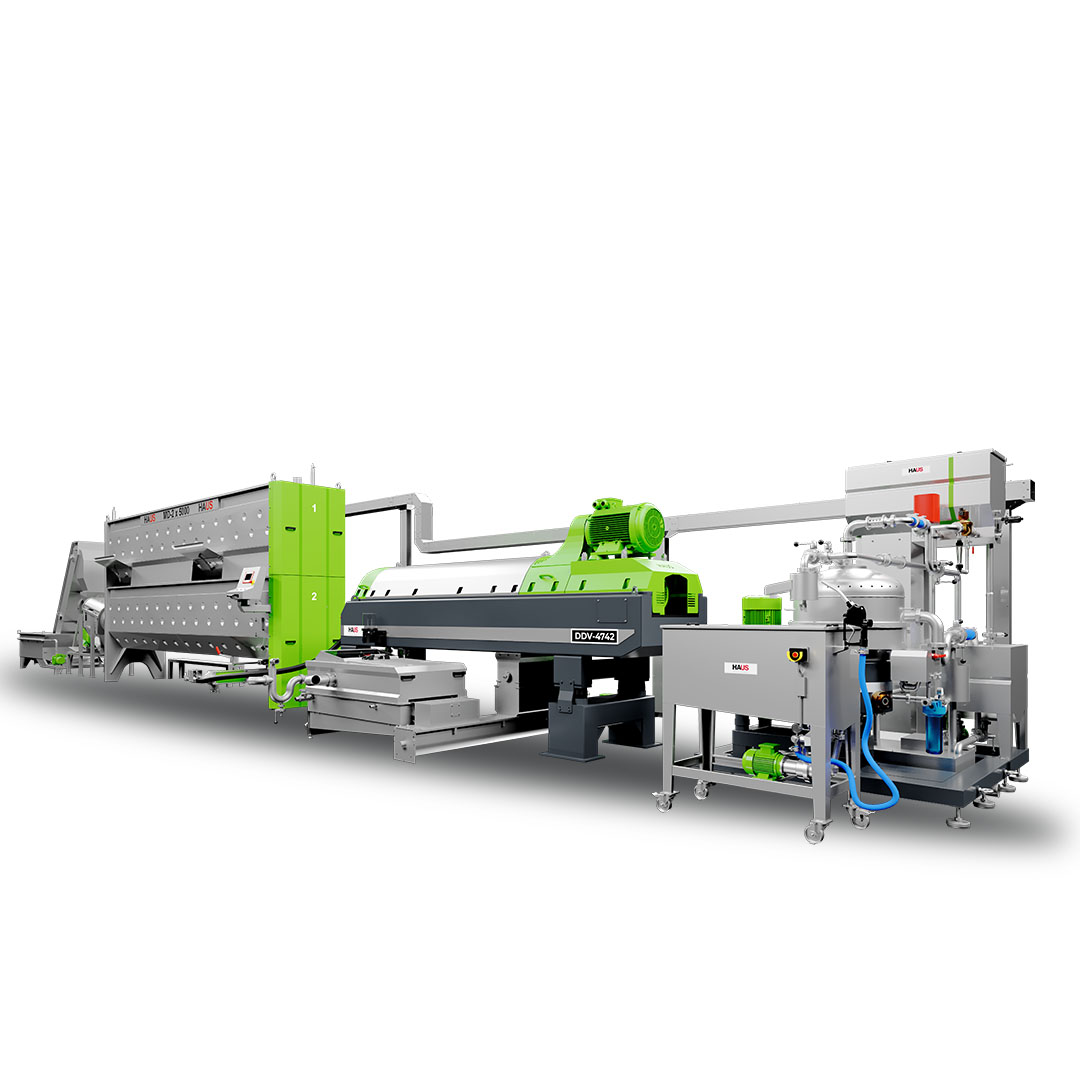
When the avocados arrive at the processing plant, they first undergo a preliminary inspection. Damaged, rotten, or otherwise unsuitable fruit is sorted out before entering the production line. The inspected avocados are transferred continuously and in a controlled manner to the washing unit via the conveyor system.
The avocado washing machine is the first main piece of equipment in the production line. It removes soil, sand, dust, and other foreign materials that accumulate on the fruit surface during harvesting and transportation. The avocados are first placed in the water tank to soften coarse dirt and soil residues on their surfaces. After surface cleaning by water circulation, the fruit is rinsed by spraying with clean water. After washing is complete, the avocados are directed to the conveyor belt and air-dried during transfer.
The washed avocados are fed continuously and in a controlled manner into the avocado pit separator-crusher machine via a conveyor. The machine’s special rotor system breaks down the fruit in a controlled manner, separating the peel, fruit flesh, and pit from one another. The pits are separated from the fruit flesh through a special screen system that utilizes differences in size and hardness, and are discharged from the system through a separate outlet. The pitted fruit flesh is broken down to the desired particle size within the rotor and screen system to produce a homogeneous puree. The homogeneous avocado paste obtained at this stage is suitable for the malaxation process.
The avocado paste prepared in the pit separator-crusher machine is fed continuously and in a controlled manner into the malaxer using a lobe pump. Inside the malaxer, the avocado paste is gently mixed at low speed and controlled temperature by the screw system. During this process, the small oil droplets in the paste coalesce into larger droplets, allowing the oil to be released from the fruit tissue. During the malaxation stage, carried out under conditions appropriate to the type of avocado being processed and the process requirements, the avocado paste is malaxed in a controlled manner at 30–45 °C for approximately 40–45 minutes under reference process conditions. As a result of malaxation, the avocado paste becomes suitable for separation of free oil, liquid phase, and solids in the decanter centrifuge.
After malaxation is complete, the avocado paste is fed into the HAUS decanter centrifuge to separate the oil from the solid phase and vegetation water. The high centrifugal force generated inside the decanter separates the avocado paste into phases according to differences in density. The process produces three main outputs: "Avocado oil phase", "Liquid phase", "Pomace or cake phase" The quantities of liquid and pomace at the decanter outlet may vary depending on the variety, ripeness level, moisture content, solids content, and oil content of the processed avocados. The crude avocado oil obtained from the decanter centrifuge is directed to the disc stack separator for final purification.
The crude avocado oil from the decanter outlet may contain a certain amount of free water, fine solid particles, and sediment. The crude oil is fed to the HAUS separator at the final purification stage. The high centrifugal force generated by the separator removes free water, fine solids, and sediment from the oil phase. This process produces high-purity avocado oil free from liquid and sediment.


PRODUCTS OF THE APPLICATION

You May Also Be Interested


HAUS

How Can We Help You?


#BECAUSEWECARE


HAUS Sales Offices and Service Network
It provides the highest quality service with the most up-to-date technology to all its customers at authorized dealer and service locations in Turkey and around the world.


750+
Employees
100000
Production Area
70
Countries


VIEW ALL DEALERS AND OFFICES


Frequently Asked Questions


Have a question? You can start searching here:


For the contact information please click here.
"For more than 70 years, HAUS has been synonymous with accomplishing high production quality, based on modern technologies; fulfilling customer satisfaction at utmost level dating back to 1954, when the young engineman Hakkı Gözlüklü has opened the doors of HAUS in Aydın and started activities. Between 2010 and 2018, HAUS Ist in İstanbul, HAUS Europe B.V. in the Netherlands, HAUS SEA in Malaysia, HAUS MED SRL in Italy, HAUS IBERICA in Spain and HAUS SA in India were founded. HAUS R&D Center was established in 2015 and the first turbo blower and screw press production began in 2017. Today, having the ability of manufacturing approximately 600 centrifuges annually with over 750 employees based on 100.000 m2 field integrated factory in Aydın - Turkey with latest technology equipment and quality system management, HAUS exports to more than 70 countries. For more detailed information about us: http://hausworld.com/page-17-about-us.html "
"HAUS manufactures a comprehensive portfolio of high-quality centrifuge technology products such as; • Decanter centrifuges, • Disc stack separators, • Continuous system olive oil extraction plants, • Screw presses, • Turbo blowers, • Mobile units and auxiliary equipment and offers familiar service on set-up, turn-key integrated project management, maintenance, spare-parts and aftersales solutions for specific markets and industries."
"Before the machines are unloaded from the vehicle or the container, the general control must be made, and the machines condition must be recorded with photographs or video if possible. The date, time and location of the damage should be noted. As soon as the damage is detected, a report must be signed by the driver of the vehicle, the number of damaged containers must be indicated on the CMR convention and the signature of the carrier must be taken. CMR insurance will then be activated. In case of shipment damages, the damage report prepared with the logistics company should be directed to HAUS, meanwhile, the relevant insurance expert should be informed immediately and act according to the expert's instructions. It should not be forgotten that you may have to pay material damages due to transactions that are not done correctly on time. For more detailed information, you can request assistance from the relevant HAUS Sales department or After Sales Services department."
For your requests, please kindly fill related service form with details: http://hausworld.com/contact.html
"First of all, you should carefully read the user operation manual provided with your machine and make sure that the specified suggestions and instructions are followed completely. You should choose your operators among those who are trained or willing to keep up. Full participation in the operator training given by the personnel sent during commissioning should be ensured and people who do not receive this training should be prevented from interfering with the machine. It should be ensured that the relevant operators of all shifts are ready for this training in the commissioning training. You should pay attention to the maintenance and cleaning of your machine, make sure that the maintenance plan is fully implemented and make sure that the controls specified in the user's operating manual are carried out. During maintenance, you should pay attention to the use of original spare parts. While using your machine, attention should be paid to the errors and warnings on the user screen, it should be checked by observing that the operating parameters are in accordance with the given values. It should be ensured that the usage limits are not exceeded, in case of any contrary, the machine should be stopped immediately with the methods specified in the user manual and should be contacted with after sales services department. Use oils recommended by HAUS After Sales Services for machinery and auxiliary equipment. Upon request, HAUS After Sales Services department provides on-site machine usage training. You may fill related form to proceed further: http://hausworld.com/page-30-customer-services.html "